Grafton's Flock Cameras Track Every Vehicle, Without Warrants
Grafton, Wisconsin operates Flock Safety automated license plate readers (ALPRs). They photograph every passing vehicle, store the data for 30 days, and make it searchable by 1,294 organizations across 32 states. In the 30 days ending August 7, 2026, the department's own transparency portal reported 211,813 unique vehicles detected. This site documents the facts.
Sources: Grafton WI PD Flock transparency portal as published August 7, 2026 (cameras, organizations, states, vehicles detected); Village of Grafton contract and budget records (see documents). Village budget documents describe seven cameras; the department's portal reports nine (why the numbers differ).
Why This Matters to You
These cameras aren't just watching criminals. They're watching everyone. Every trip you make through Grafton may be photographed, logged, and stored in a database accessible to agencies 1,800 miles away.
Your driving patterns can reveal your place of worship, medical visits, political activity, and personal relationships. While Grafton deletes its data after 30 days, any of the 1,294 organizations with access can download and permanently store your location history, and Grafton residents have no way to know who accessed their data or why.
This is not just a Grafton issue. The ACLU's "Get the Flock Out" campaign estimates Flock now operates between 80,000 and 100,000 devices across more than 5,000 U.S. communities, performing more than 20 billion license plate scans every month.
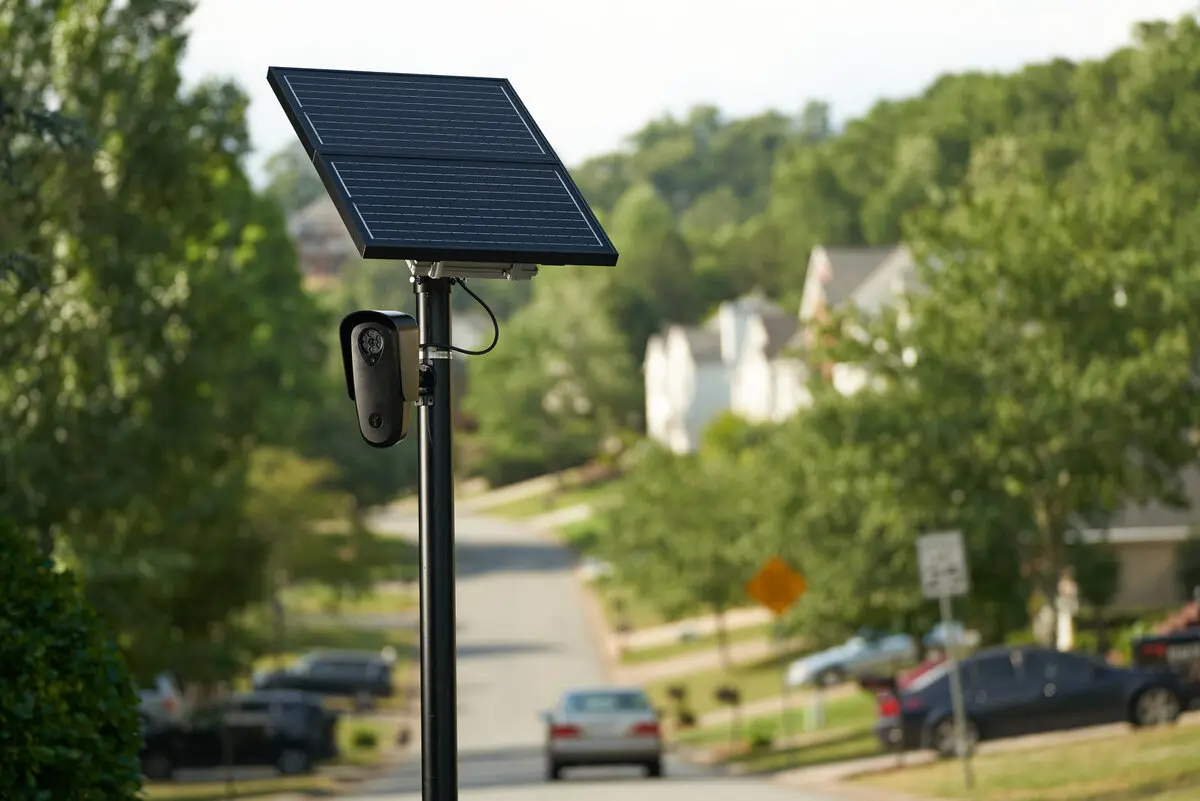
A Flock Safety automated license plate reader camera. These solar-powered cameras photograph passing vehicles' license plates, with the data stored for 30 days and shared with 1,294 organizations across the US.
The Scale: In the 30 days ending August 7, 2026, Grafton's cameras detected 211,813 unique vehicles and produced 823 hotlist hits. That is roughly one hit for every 257 vehicles, meaning about 99.6% of vehicles detected in Grafton set off no alert of any kind. Nationally, a 2021 EFF analysis of California ALPR data found 99.9% of scans were unrelated to any criminal investigation or public safety interest at the time of collection. This isn't targeted law enforcement. It's mass surveillance.
New Hampshire law requires ALPRs to delete records of vehicles that don't match a "hot list" (stolen vehicles, AMBER Alerts, wanted suspects) within 3 minutes. Grafton keeps records of every vehicle for 30 days.
30 daysHow long Grafton keeps data on innocent drivers
3 minutesHow long New Hampshire keeps data on innocent drivers
Grafton retains innocent drivers' data 14,400 times longer than New Hampshire's flag-and-discard model, which still finds stolen cars and alerts police to wanted suspects.
The map below shows crowdsourced ALPR camera locations from DeFlock, an open-source project mapping surveillance cameras worldwide. Data is community-verified and updated daily via OpenStreetMap.
About the Data: DeFlock is a crowdsourced ALPR mapping project, backed by the Electronic Frontier Foundation (EFF) after Flock Safety attempted to shut it down with a cease-and-desist. As of July 2026 it had mapped more than 95,000 Flock cameras and over 116,000 ALPR cameras of all brands nationwide. All data comes from community contributions to OpenStreetMap and is regularly verified.
On Grafton's camera count: Village budget and contract documents describe seven village-owned cameras. Grafton PD's transparency portal reported nine as of August 7, 2026 (see the discrepancy). DeFlock's crowdsourced map may show a different number again, since it depends on what volunteers have physically spotted and tagged. Separately, private entities including Grafton Commons share camera data with Grafton Police; those are not village-owned and are not counted in either figure.
Communities Are Reversing Course
More than 30 U.S. cities, led by both conservatives and progressives, have removed, suspended, or rejected Flock cameras after discovering unauthorized federal access, constitutional concerns, and minimal crime-reduction benefits. Trackers counting cumulative contract terminations since 2021 put the figure well above 80.
Evanston was forced to remove 19 cameras after a state audit. Eugene, Oregon terminated its contract and, when Flock said it would not start removing cameras for another six weeks, city staff took down 55 of 57 themselves. Denver's council unanimously rejected a $666,000 extension; the mayor signed a $498,500 one instead, $1,500 under the threshold that would have required council approval, and all 110 cameras came down when it expired in March 2026.
Having nothing to hide doesn't mean you have no need for privacy. You probably close the door when using the bathroom, close curtains at night, and password-protect your phone, not because you're doing something wrong, but because privacy is a basic human need.
The Fourth Amendment protects this principle: government shouldn't track your movements without individualized suspicion. It's not about hiding criminal activity. It's about maintaining freedom from constant government surveillance.
"Don't we need these cameras to catch criminals?"
The question isn't whether ALPRs can help investigations. It's whether we need to track EVERYONE to catch the few who commit crimes. New Hampshire's model shows you can have real-time alerts for stolen vehicles and wanted suspects while deleting data on innocent people within 3 minutes.
You can have effective law enforcement AND constitutional protections. Multiple independent studies show ALPRs have minimal impact on crime reduction, while creating massive privacy costs.
"If this violates the Fourth Amendment, wouldn't courts have stopped it?"
Constitutional challenges are expensive and time-consuming. Many ALPR cases are still working through the courts. In 2018, the Supreme Court ruled in Carpenter v. United States that comprehensive location tracking requires warrants, but lower courts haven't yet definitively applied this to ALPRs.
Just because something is currently legal doesn't mean it's constitutional. Segregation was legal until courts ruled otherwise. No Wisconsin court has addressed this issue.
"The police say they only use it for legitimate investigations. What's the problem?"
Grafton's policy prohibits misuse, but enforcement relies entirely on police self-auditing. There's no independent oversight, no public reporting, and the department doesn't track how external agencies use Grafton's data.
We've seen documented abuses in other communities (officers stalking ex-partners, unauthorized searches) even where policies prohibited such use. Good policies aren't enough without independent oversight and accountability.
"Isn't this just like security cameras in stores?"
It is a fair question, and two common answers to it are wrong. Police can get private security footage without a warrant, because businesses hand it over voluntarily all the time. And store cameras are no longer necessarily standalone: Flock sells to retailers directly, and Grafton's own network receives data from Grafton Commons, Blain's Farm and Fleet, and Home Depot Corporation.
The real differences are about structure, not ownership:
Fixed scope. A store camera covers one property. Grafton's cameras sit at the village's points of entry and exit, so passing through town at all means being recorded.
No automated plate indexing. Store footage is video nobody has read. ALPRs convert every passing vehicle into a structured, text-searchable database record the moment it is captured.
No cross-jurisdictional query interface. To get store footage, an officer has to identify the store, ask, and be given it. Grafton's data is queryable by 1,294 organizations from their own desks, without asking Grafton.
No default retention of everyone. Most store systems overwrite footage on a loop and nobody ever looks at it. Grafton's system deliberately retains a searchable record of every vehicle for 30 days.
The distinction isn't public versus private. It's the difference between footage that exists and a database that has already been built, indexed, and opened to a thousand agencies.
"What about people who support these cameras? Are they wrong?"
Supporters make valid points about investigative benefits:
ALPRs can help solve property crimes and locate stolen vehicles
They provide objective evidence for investigations
The cost is relatively modest ($2,500/camera/year)
These are legitimate considerations. Our position is that these benefits don't require tracking EVERY person's movements. New Hampshire's flag-and-discard model achieves the same law enforcement goals while better protecting civil liberties. It's not law enforcement vs. privacy. It's finding the right balance.
Ready to Take Action?
Seven practical accountability measures the Village could adopt today, plus how to contact officials and make your voice heard.